Millions of adults and children in England could face longer waits for mental health support, as new survey data reveals the scale of cuts being planned across the NHS mental health system for the coming year.
Survey reveals depth of the crisis
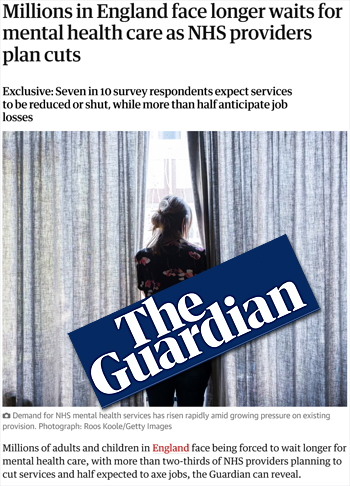 The findings come from a national survey conducted by the NHS Alliance in March, ahead of the new financial year, and shared exclusively with the Guardian. Of the 37 NHS mental health trusts that responded, around two-thirds expect to reduce or shut down some services in 2026-27 as they work to close budget gaps. Roughly six in 10 trusts said they plan to freeze vacancies, and a similar share expect to cut the number of clinical staff on their books this year.
Trust leaders who responded to the survey described their community mental health teams as stretched and under-resourced even before accounting for planned cuts, with rising demand outpacing available funding.
Which services are at risk
The trusts flagged a wide range of services as vulnerable to cuts or closure, including:
- Child and adolescent mental health services (CAMHS)
- Talking therapies
- Crisis support for adults experiencing a mental health emergency
- Addiction and substance-use support
- Community outreach programs, including those serving ethnic minority and low-income communities
Experts warn that scaling back these services won't just affect mental health patients directly — it could also increase pressure elsewhere in the NHS, strain the wider economy, and burden other public services that end up absorbing unmet need.
A tension with government ambitions
The cuts land awkwardly alongside a major government announcement earlier in the week. Prime Minister Andy Burnham revealed plans to build a network of nearly 200 community mental health centres and dedicated mental health emergency departments by 2029, framing the initiative as a way to make it easier for people to access the right support at the right time.
Mental health charities and campaigners broadly welcomed that long-term vision, but cautioned that it risks being hollowed out if day-to-day funding for staff and services keeps shrinking in the meantime. Tom Pollard, head of policy, public affairs and campaigns at the mental health charity Mind, said the survey results illustrate just how difficult it will be to protect mental health services in England, arguing that cutting funding for frontline staff and services now makes it far harder to deliver the kind of open-access, community-based model of care the government has promised.
One trust's budget shortfall — and a wider pattern
The Guardian previously reported that East London NHS Foundation Trust is planning extensive service cuts and hundreds of job losses in order to close a £25 million funding gap. But those working in the sector say this is far from an isolated case.
An NHS consultant psychiatrist, speaking anonymously, said similar — or worse — situations are unfolding at mental health trusts across the country, with many responding in the same way: cutting jobs and scaling back what services they can safely deliver. A service manager at a separate trust echoed this, pointing to several consecutive years of declining funding combined with mounting cost-reduction targets as the root cause.
Staff at multiple trusts say they're worried the cuts will erode services to the point where they can no longer reliably do their jobs or guarantee patients get safe, timely care.
Warnings from sector leaders
Alex Stewart, assistant director of the NHS Alliance's mental health network, acknowledged there are still pockets of innovation and strong care within the system, but said the financial pressure is now visibly reshaping services. He noted that mental health trusts are especially exposed during periods of tight finances because staffing accounts for such a large share of their budgets.
Stewart also raised concern that mental health's portion of overall NHS spending appears set to shrink for a third year running, despite recent government announcements on capital funding for new community centres and access targets. He argued that allowing mental health investment to keep falling behind will have serious knock-on effects — not just for patients, but for the broader NHS, the economy, and other public services.
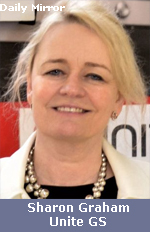 Unite general secretary Sharon Graham was more pointed in her criticism, arguing that balancing NHS budgets by cutting mental health provision simply defers costs rather than eliminating them, and predicting they'll come back larger down the line. She said Unite members at affected trusts are angry about the proposed job and service cuts and plan to resist them with the union's backing.
Government response
A Department of Health and Social Care spokesperson defended the government's record, pointing to £16.1 billion earmarked for mental health services this year, more than 8,500 additional mental health workers recruited since the government took office, and a recently announced £343 million investment funding 159 new NHS mental health facilities nationwide. The spokesperson said a forthcoming mental health strategy would set out how the government plans to "future-proof" the system, including measures aimed at cutting waiting times and improving early intervention.
However, a true analysis of the situation and taking into account the Government's continuous push towards the prvate healthcare sector in place of NHS provision, shows the direction of travel:
When NHS trusts face waiting-list pressure and budget cuts, and ICBs are simultaneously being squeezed on running costs, commissioners often turn to independent-sector providers for spot capacity — this has long been true for things like inpatient beds for complex needs, as the Nuffield Trust piece has recently mentiond.
Government claims that's less a deliberate ideological push and more a pragmatic release valve when public capacity can't keep pace with demand.
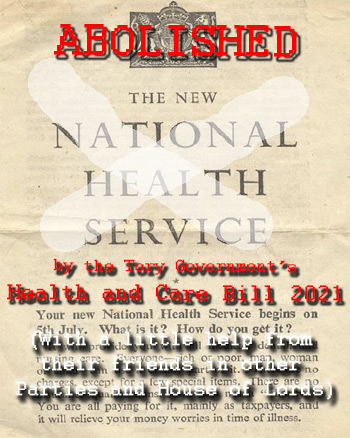 However, a combination of shrinking ICB budgets, trust-level cuts, and rising demand does create conditions where using independent or voluntary-sector capacity becomes more likely by necessity — which is exactly the "underfunding leads to privatisation by stealth" argument campaign groups like Keep Our NHS Public have been making.
More importantly, it gives the Government an opportunity to hide it's true intentions, by claiming gaps are being filled by the private sector and by denying situation is not "urged by government" or "a predictable consequence of the funding settlement". Whilst it very well knows this is privatisation by stealth and under the badge of NHS, just as Tories Oliver Letwin and Jonathon Redwood stated in the Thatcher era of the 1980s!
This Labour Government is busy copying the US system of Accountable Care Organisations, transferring ALL NHS healthcare to the private sector, and ensuring that the public pay the bill for private healthcare profiteering in the UK delivered under the badge of the NHS, and their sham Blair-promise that healthcare will remain 'free at the point of delivery'. The NHS is not free and never has been. But now it will deliver huge profits for private healthcare companies via an ever decreasing level of service just as in the US.
Taxation and National Insurance contributions will be used to provide national private healthcare.
Source: NHS England / The Guardian / DHSC /